
Faro Takes Classical Experience and Helps the Living
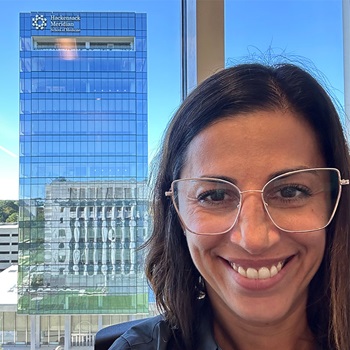 Elissa Faro, Ph.D., has a background unlike any other at the CDI. Archaeologist by training, she traveled to legendary sites and held ancient artifacts. She pursued the understanding of history from the perspective of the people who didn't win wars, or lead empires, or even warrant mention in the vaunted histories. She saw it all as a pathway to how researchers can begin to understand all the other people's lives and experiences through the material record, not just the dominant narrative.
But the needs of the living are more pressing than those of the dead. Health care beckoned to her, and her work has drawn her to those who are not necessarily part of the dominant wellness narratives right now. Her aim: to help improve lives in need, right in the here and now.
“My first projects were focused on individuals living with sickle cell disease with implicit issues of disparities and equity and it was really eye-opening to see first-hand how structural disparities embedded in the system impact not only health outcomes but care delivery as well,” Faro recently recalled. “I always wanted to explore how to understand the people who history sort of silenced, and then even further back, but that seems in my mind like a really easy jump over to exploring how to understand the people the healthcare system has failed, and then trying to do something about it.”
Faro, one of the most recent expert recruits to the CDI, is a medical anthropologist and implementation scientist. Her doctorate is in classical art and archaeology and she started her career in academia. Yet over 15 years she has used her expertise in human systems from the ancient buried past - and brought them to bear in the health-care landscape of the 21st century.
“Elissa Faro is an enterprising scientist who is finding ways to make an impact in the community - which is a vital focus of the CDI’s outreach,” said David Perlin, Ph.D., chief scientific officer and executive vice president of the CDI.
Academia
Faro, who grew up in Boston, fell in love with antiquity during years of boarding school. Studying Latin and Ancient Greek and Italian with exceptional educators inspired a love of Rome, and the ancient world. Together, it led to adventures of the mind - and world-spanning voyages. She studied at Vassar for her undergraduate degree, and she studied abroad in Rome in a stint specifically for archaeology at the Intercollegiate Center for Classical Studies. After her bachelor’s pursuit, she spent a year in a fellowship at the American School for Classical Studies in Athens. The passion for the past was tangible. The first time she held a Cycladic figurine - one of those Neolithic figures with oversized heads and crossed arms - it lit a spark for her.
“I thought, ‘I’m going to study prehistory’ - and that’s how I decided to go to grad school for the Bronze Age,” she said.
That pursuit led to a master’s and doctorate from the University of Michigan, and included world travel to a remarkable obsidian cliff in Eurasia, criss-crossing the Mediterranean, and thrilling exploration of caves and ruins. Of special note was her time on Crete and islands in the Aegean Sea, since her niche was the Minoan civilization. Along the way she was also a visiting assistant professor at Dartmouth College, and a lecturer at Brown University.
It amounted to a developing expertise, and wisdom, of understanding how humans organize themselves into systems of varying complexity.
Bringing Expertise to Bear for the Living
That expertise of human societies has applications beyond antiquity. The promise for its application in the present is what drew Faro to health care.
The dead were static, and stuck back in time. The living holds a more-dynamic potential for career impact, as she started to realize. The transition was not immediate. For example, for a short while she was a licensed New York City tour guide, among other gigs.
The first long-term step into health care was as a project manager then senior analyst at the National Institute for Children's Health Quality in Boston. It was a role assessing population-level health trends - the first topic was sickle-cell disease, and early on she was tapped to do a national measurement and assessment of the condition, based on her background and particular set of skills. Specifically, she was already a Ph.D., so colleagues knew she already knew how to write a comprehensive report on the findings.
“The through-line is really systems - how humans organize themselves,” she said, explaining that the studies eventually included other topics such as infant mortality. “But one of the most important aspects is the power dynamic inherent in those systems - the development of sociopolitical complexity is actually the development of hierarchy.”
Eventually the scope of her work led to the next phase - and back to New York City, and the Albert Einstein College of Medicine. She worked in the department of pediatrics, eventually as an associate director of pediatric quality at the Children’s Hospital at Montefiore. While working at Montefiore Einstein she expanded improvement science into implementation research. This included assessments of breastfeeding rates in the NICU, ethnographic inquiry into the pediatric emergency department, and investigations with the Centers for AIDS Research (CFAR) which included trips to central Africa, while teaching a year-long quality improvement course for MDs, nurses, and staff.
From there, she made an important jump to the University of Iowa in 2020, in the midst of the COVID-19 pandemic, where she found herself for the first time in a healthcare environment with many other anthropologists. It was a welcome chance for professional growth.
“I hadn’t ever been around other anthropologists working in health care and implementation research in 10 years, so it was a really great opportunity to merge those two sides of my professional experience,” she said.
In Iowa she furthered the experience that has now brought her to the CDI - especially an all-important National Institutes of Health (NIH) grant that is powering her work now.
Making an Impact
The IMPACT Study is now truly taking shape as Faro has acclimated to the CDI. A product of a growing network with Iowa and Indiana health officials and community partners, it’s a hybrid implementation-effectiveness-context trial focused on implementing an evidence-based mental health intervention into home visiting programs for women in the perinatal period for the underserved across the two states. It uses the “Mothers and Babies” intervention and assistance to help mothers who need support to get early and proactive help to ensure a good start, by working with such partners as Healthy Families, Parents as Teachers, and state health agencies.
Another major project is as a Senior Implementation Scientist for the NIH's IMPROVE initiative, focusing on maternal health outcomes for pregnant women in the Winnebago Tribe of Nebraska. While the challenges are in a different culture and setting, underserved populations still are impacted by the same limitations: time, money, and resources. All of these disproportionately hit certain groups, which attracts Faro’s professional curiosity, and inspires her every day.
“I naturally gravitate toward women and children because those are the people who are generally most underserved in health care.”
Throughout her career, Faro has also been actively involved with the National Institutes of Health (NIH), including an 10-year role in the Environmental exposures on Child Health Outcomes (ECHO) Program. In this capacity, she has been instrumental in developing principles for participant engagement and strategies for involving research participants in novel ways. In fact, it was her involvement with ECHO, and a partnership with Dr. Judy Aschner of the CDI, which led her to learn of the CDI, and what helped her decide to bring her ongoing work to New Jersey.
“All the gold monkey statues had been found by the time I became an archaeologist," she quipped, “so now I just have to content myself with changing the world. Why else would would I be doing any of this, you know?”
Personal
Faro grew up in Boston as an only child, and was close with an extended family of cousins. But an eager inquisitiveness has powered her travels, the evolution of her work, and her personal interests. Before arriving at the CDI, she took the chance to train as an EMT. Once nationally certified in the near future, she plans to volunteer with the local First Aid Squad. Ultimately, she hopes to turn it into another NIH-funded R01 implementation project looking at community paramedicine to reach underserved communities in NJ and elsewhere.
Her hobbies and interests are always evolving, and she is continuously striving to learn new things. She has learned glass blowing, hip-hop dance, pottery, in addition to furthering her work. Being on the move is a constant: for miles of walks, she has her big fluffy dog Samson at her side.