
CDI Scientists Identify Key Dynamic to Boost Cancer Treatments While Limiting Stem Cell Transplant Rejection
April 27, 2026
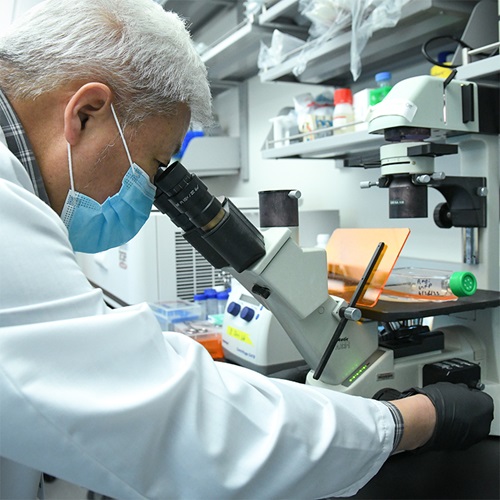
A key molecular dynamic could be the key to fighting tumors while allowing patients to still receive life-saving cell transplantation, according to the latest finding published by a team of scientists from the Hackensack Meridian Center for Discovery and Innovation (CDI).
The findings could have resounding impacts for allogeneic hematopoietic stem cell transplantation (allo-HSCT) and CAR-T cell therapy, according to the data.
The paper “EZH2 and intracellular Ca2+ signals interdependently coordinate alloreactive and CAR T cell responses,” was published April 22 in the Nature journal Cellular and Molecular Immunology. The team included lead author Yi Zhang, M.D. Ph.D., and first author Ying Wang, Ph.D., among colleagues from multiple institutions.
The interrelation between the enzyme EZH2 and the Ca2+ calcium cellular signaling pathway could be harnessed to allow such interventions as CAR T-cell treatments for cancer more effective and sustained, while balancing the molecular interplay so that graft-versus-host disease (GVHD) does not effectively reject stem cell and other transplants, according to the findings.
Using experimental GVHD and CAR T-cell therapy models, the team demonstrated that the EZH2 enzyme is a kind of brake on the calcium signaling pathway in activated T cells, protecting them from accelerated cell death, according to the authors.
Simultaneously, the team found that the calcium signaling could modulate the effectiveness of the EZH2; therefore, inhibiting the calcium boosted the EZH2 in the CAR T cells, “improving their efficacy in tumor control.”
“This dynamic interplay between EZH2 and Ca2+ signals is vital for maintaining a balance that prevents T cells from falling into either “death” or exhaustion,” write the authors. “Together, EZH2 and Ca2+ signals serve mutually opposing roles to fine-tune gene programs required for productive T cell responses.”
The balance of these factors could point the way toward a best-case scenario to cancer patients who need both interventions - fighting the cancer, while strengthening the body to survive the treatments doing so - they conclude.
“Results from these studies may provide novel insights in the epigenetic mechanisms that control Ca2+ responses critical for productive T cell immunity in the context of alloimmunity, autoimmunity, chronic infection, and tumor immunotherapy.”
The Zhang Lab is targeting how T lymphocytes (T cells), which are a critical component of the human immune system, contribute both to disease development - and how they can be harnessed to cure cancer. Zhang said in a recent interview that he and colleagues are pushing the envelope of this scientific niche toward several goals: cracking the riddle of transplant rejection; and creating novel drugs to boost immunotherapies against the cancer itself.